
Many guides to starting a concrete raising business focus on the numbers and skip the part that decides whether you last: what the work actually demands of you, your equipment, and the people around you.
This is meant to fill that gap. No pricing tables, no timelines, because everybody’s numbers and everybody’s ramp-up will be different. What follows is the set of things you need to understand, obtain, or plan for before you take money from a customer.
What the work actually is
You are injecting expanding polyurethane beneath a settled slab to lift it back to grade, or to fill the voids underneath it so it stops moving.
The mechanics are simpler than they look and harder than they sound. You drill a hole through the slab, seat an injector in it, and pump two-part polyurethane through the injector into the space below. The material reacts, expands, fills voids, compacts loose soil, and — once the resistance beneath the slab exceeds the weight above it — begins to lift.
The lift is the part that separates operators from equipment owners. You cannot see what is happening underneath. You are reading the slab: watching for the first hairline of movement, judging how much material to send before you stop and wait, and knowing when it’s time to start injecting a different area. It’s more artform than science.
Void filling is its own service and worth understanding on its own terms. Plenty of slabs are still at grade but have washed-out voids beneath them. Filling those voids is the job. Nothing needs to move.
What you are actually selling
You are selling a solution to a problem that is also an alternative to replacement.
A homeowner with a sunken walkway has three real options: live with it, replace it, or lift it. Replacement means demolition, disposal, new concrete, curing time, and a slab that no longer matches everything around it. Lifting with polyurethane means holes the diameter of a dime, a few hours, and use of the surface the same day.
Understand the alternatives properly, including the older methods. Mudjacking — pumping a cementitious slurry beneath the slab — solved the same problem for decades and is still in use. Knowing how it works and where it differs from polyurethane makes you more credible in front of a customer, not less. You will get asked.
Your support system and your rig are one decision
These are not two steps in an order. The support you end up relying on comes attached to the equipment you buy and to the people you buy it from, so you are choosing both at once whether you intend to or not. The only question is whether you chose the second one deliberately.
While you are still deciding on a rig, find people who already run that exact equipment, and who are successful doing this work. Not people in the industry generally — people on the same machine you are considering. Equipment behaves differently in the field than it does in a brochure, and the operators running it know things that are not written down anywhere.
Then go further and arrange to shadow a crew. Watch how they lay out a job, where they drill, how they sequence injections, when they stop. A day beside a working crew will answer questions you didn’t know you had, and teach you things that months of reading will not.
When you choose a supplier, look past price and delivery. Find one with an actual support department, staffed by people who have run rigs and done jobs themselves. There is an enormous difference between a supplier who can troubleshoot your equipment and a supplier who can also tell you how to approach a difficult slab. When you are standing on a job that is not going the way you expected, the second kind of supplier is worth more than any discount.
HMI is the clearest example of that in this industry. They ran their own concrete lifting company, RaiseRite, before they ever built equipment to sell. RaiseRite has been lifting concrete in Wisconsin since 1974 — over fifty years — and is still out doing jobs today. New equipment goes to those crews first and stays there until the operators would rather use it than what they had. The practical effect for you is that the person picking up your support call has stood on a slab with the same gun in their hand, on a job that was not going well, in weather. That is a different conversation than a parts desk reading from a manual — they can talk you through the equipment, the material, and how to approach the job in front of you.
Whoever you end up buying from, ask who staffs their support line and what those people did before they took the phone. The answer tells you what that support is going to be worth in your second season.
That relationship is the closest thing to a safety net this business offers. Establish it before you need it.
Training, and the shortcut most people skip
The advice above — find operators running the machine, then go shadow a crew — sounds like something you have to arrange through favours and goodwill. You do not. All three of the suppliers built around this work run formal training, and for someone starting from nothing it is the fastest way to compress a season of expensive mistakes into a few days.
HMI runs a two-day Discovery and Training seminar in Manitowoc, Wisconsin, several times a year, currently $595 an attendee with spouses free. It is pitched at people with no concrete background at all, and covers estimating and bidding, scheduling work so it is actually profitable, running and maintaining the equipment, and marketing to residential, commercial and municipal customers, with hands-on time raising real slabs rather than watching a demonstration. HMI sells and supports mudjacking systems as well, and their materials list mudjacking alongside polyurethane in the seminar curriculum. It is not a franchise and no territories are attached to it. You can travel a day early and shadow the RaiseRite crews on live jobs at no charge — the crew-shadowing advice above, arranged for you. That shadowing can be booked on its own as well, roughly April through November. Once you own a system there is a further class, free to their customers, on gun rebuild, proportioner troubleshooting, pump maintenance and lifting technique.
Alchatek runs contractor training in spring and autumn, two to three days, and casts wider than slab lifting alone. The lifting side covers safety, site evaluation, estimating, product selection, sales, equipment and technique, plus deep lift work for the jobs where the real problem is under the sub-base rather than in the slab. There is a separate two-day public works course aimed squarely at municipal work and the contractors who bid it, and shorter half-day product labs run at local distributors. It is built for experienced contractors filling in gaps as much as for people starting out.
NCFI runs a geotechnical training course twice a year out of Mount Airy, North Carolina, combining classroom sessions, on-site demonstrations and hands-on raising. The emphasis leans technical: how the polyurethane actually behaves, injection design, single versus dual component systems, and keeping the equipment running.
Any of the three will teach you more in two days than months of reading will. Go in understanding the shape of them, though. All three are run by companies that sell equipment and material, and a training fee credited against a purchase is designed to lead somewhere. That does not make them bad deals — two days of hands-on instruction is cheap next to learning the same lessons on your own customers’ driveways. Just know what it is while you are sitting in it.
The rig, and what you are committing to
The rig is the centre of the operation: a proportioner that heats, meters and pressurises the two components, mounted in a trailer, van or box truck with your hose reel, compressor and material.
Graco and PMC are the two proportioner manufacturers, and that matters more than it first looks: whoever’s name is on the trailer, there is a good chance one of their machines is inside it. Who you actually buy that rig from is a separate question, and it is the next section.
Buying a rig is not like buying a tool. You are buying a machine that must hold temperature and pressure reliably, in the field, in weather, and you are buying whatever support comes attached to it. That is why the support question above is not a separate step — it is part of choosing the machine.
Who you buy from, and what they actually sell
The first thing to unlearn is the idea that there are equipment companies over here and material companies over there. Most of the names in this trade sell you both, and a few manufacture the foam, package the machine and build the trailer. Sorting them by what they stock will not tell you much.
The division that actually matters is whether concrete raising is the business, or one application of a larger spray foam business.
Built around the geotechnical work. HMI manufactures its own concrete raising equipment and its own foam, and is the only one here with a contracting arm still doing jobs. Alchatek, which you may know by its former name Alchemy-Spetec, manufactures the chemical and distributes PMC equipment and injection guns alongside it. NCFI manufactures the Terrathane geotechnical line, supplies Graco and PMC machines, makes geotech-specific parts such as injectors, valves and work stations, and runs classes on the work.
Spray foam first, with concrete lifting as one of the things it does. Profoam builds custom rigs to order and carries a concrete lifting foam line. Spray Foam Systems manufactures its own equipment and rigs, including packages aimed specifically at slab lifting. Intech Equipment and Supply distributes Graco, PMC and Carlisle and builds turnkey rigs out of six locations. SprayPolyParts stocks OEM and aftermarket parts for Graco and PMC guns and builds rigs to order. CJ Spray and MaxForce sit further out again — broad spray, coatings and insulation equipment, with polyurethane as one line among several.
None of that is disqualifying. A rig builder who does spray foam all day can build you an excellent trailer, and some of these companies have been doing it longer than the concrete raising specialists have existed. But the further a supplier sits from this specific work, the lower the odds that the person answering your support call has ever lifted a slab — which is the whole argument of the section above, in a different form.
One disclosure, plainly: our experience is with HMI. The others are listed here so you know who exists and who to call, not as recommendations we have earned the right to make. Do your own diligence on any of them, and weight it toward the ones whose people have done the work.
Trailer, van, or box truck
The proportioner has to live somewhere, and that choice shapes your working day more than most people expect.
A trailer can be the cheapest way in and the easiest to replace - especially smaller ones. You can unhitch it and use the truck for something else, and when the rig needs work you can drop it at a shop without losing the vehicle too. What you pay for that is access. Backing a trailer down a tight residential driveway, or into an alley behind a row of garages, is a skill of its own — and there are jobs where you simply will not fit.
A van solves the access problem. It parks like a vehicle, and everything inside is locked and dry without a second thought. What you give up is room. Once the proportioner, reel, compressor and material are in, there is not much left over, and working inside one in August is its own kind of misery. You also give up sign space — curved panels, and fewer of them, make for a far smaller canvas than a box or a trailer.
A box truck gives you the space and the payload, room to stand up and actually work, and a presence that reads as an established company when you pull onto a commercial site. It is also the best billboard of the three. Tall flat sides wrap cleanly, and a wrapped truck parked in a driveway for three hours is advertising to the whole street.
There is no correct answer here, only a correct answer for the work you intend to take. If most of your jobs are residential driveways and walkways, weigh access heavily. If you are chasing commercial, weigh capacity.
Weigh the sign work in all three cases. Whatever you buy is going to be wrapped, and then parked in front of a customer’s house for half a day while the neighbors walk past it — several of whom have the same settled slab and have not done anything about it yet. That is the cheapest advertising you will ever run, and how much of it you get is decided the day you pick the vehicle, not the day you order the graphics.
Generators: gas or diesel
Your rig needs power, and the generator is one of those purchases that looks like a line item and turns out to be infrastructure.
Gas generators are cheaper up front and more easily available. They are also the riskier choice inside an enclosed rig: gasoline ignites far more readily than diesel, and you are storing and burning it in the same box as your heated material, your compressor and your electrical. They top out at lower output, which starts to matter on a cold morning when the proportioner, the heated hose and the compressor all want power at once. And they do not last. A gas unit run hard every working day wears out in a fraction of the hours a diesel will give you.
Diesel generators cost more at purchase and weigh more in the rig. Not an option for smaller, lighter weight trailers or small vans. In exchange, however, you get the output headroom to run everything at once without browning out, a fuel that is much harder to ignite by accident, and a machine that outlasts a gas rig 3-5 times.
If you are buying once and running it every day of a season, the arithmetic favors diesel and it is not particularly close. The gas unit is the one you regret in your second or third year.
Injection gun purge systems: mechanical, water, and air
This is the single most consequential equipment decision most new operators do not realize they are making.
Here is the problem the gun has to solve. You are injecting polyurethane through a hole roughly an eighth of an inch across, through a plastic injector, into the space beneath the slab. The material is manufactured to expand — that is the entire point of it — and as it expands, it closes off every pathway available to it, including the one you just injected through. The product seals its own route by design.
That matters because of how the lift actually works. You inject a smaller amount, wait to see how the slab responds, and then decide how much more to send. The waiting is not optional; it is how you avoid overlifting. But while you are waiting, the material is curing in your pathway.
Mechanical purge guns leave you fighting that clock. To keep the pathway open for the next injection, you have to fire small shots every ten or twelve seconds. You are no longer reading the slab — you are managing the gun, and you are putting material into the ground on the gun’s schedule rather than the job’s. If a customer walks up to talk to you, if you have to take a phone call, or if you simply need to step back from the lift to assess what’s happening, you’re left having to re-drill the pathway just to continue injecting. These are normal occurrences on nearly every job, and each one forces you to work around the gun’s timing instead of the job’s actual needs.
There is also a real risk in injecting into a hole or pathway that has closed off. Doing so builds tremendous back pressure in the system, and that pressure can lead to a blowout. When that happens, polyurethane can spray onto and stain nearby surfaces — concrete, brick, siding, windows, vehicles, and other building materials — turning a routine injection into an unnecessary cleanup and repair headache.
Water purge flushes the pathway with water between injections. It works, but it means carrying a water source and a separate water pump — something similar to an airless sprayer pump — and maintaining all of it.
Air purge continuously purges the pathway with air any time polyurethane is not flowing. Rather than racing the cure, you are holding the pathway open with something that cannot cure in it. The pathway stays open effectively indefinitely, which means you can wait as long as the slab needs you to wait.
That one change reorders the whole job. The waiting is no longer something to get through as fast as you can — it is time you can spend watching what the slab is actually doing. You can stop injecting to look at the lift from another angle, step around to the far side, talk to the customer standing behind you, take the call, and come back to a pathway that is still open. Every one of those is an ordinary event on an ordinary job, and on a mechanical gun every one of them costs you a re-drill.
It also takes the pressure out of the failure described above. You are no longer injecting into a pathway that may have closed while you were looking elsewhere, so you are far less likely to build the back pressure that causes a blowout.
When a port starts to close off, the material still has to go somewhere. With no good pathway left in front of it, it comes back up the hole and out under pressure, onto whatever is near it — the slab you are lifting, the customer’s siding and windows, their vehicle, or you. A gun with an air pressure gauge shows you that port closing while it is still only a reading on a gauge.
The cost is that you need air, and enough of it, for as long as the gun is connected. The compressor is already on the truck, so in practice this is a matter of sizing it for the duty rather than adding something new to the rig.
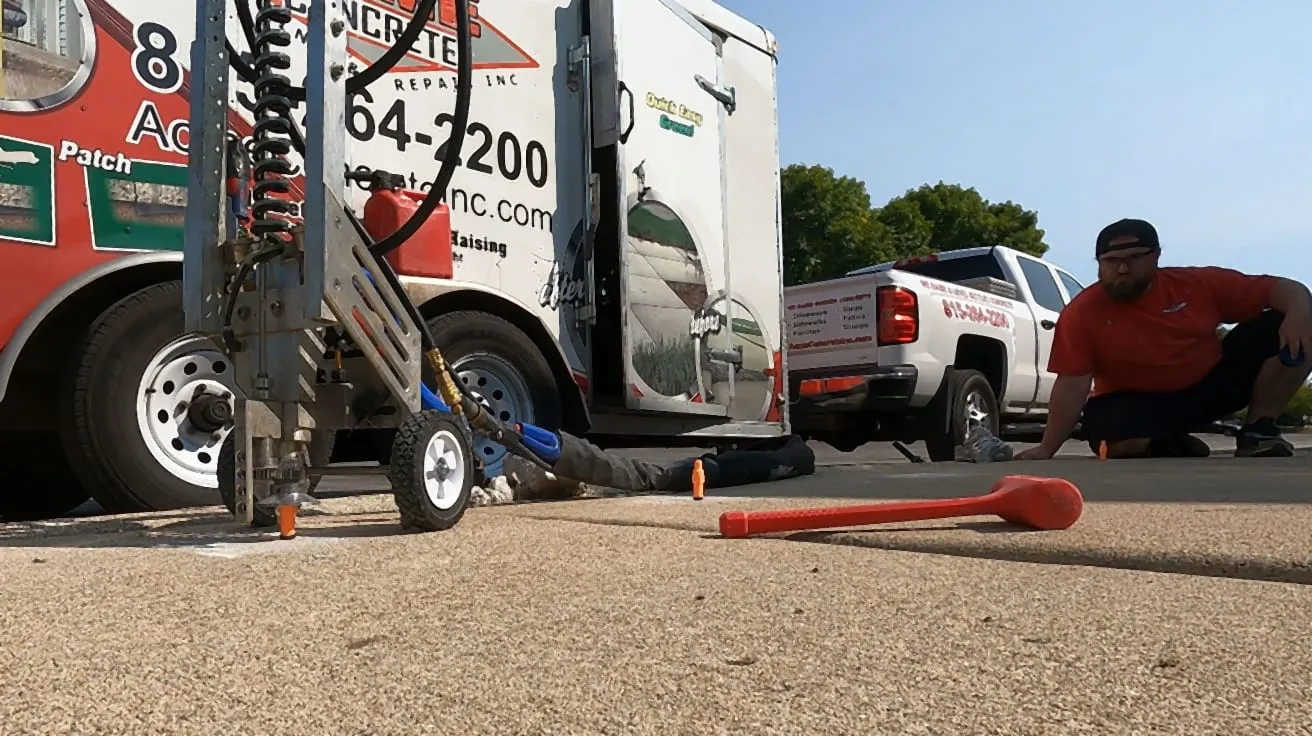
The current generation goes past purge alone. HMI’s EliteTWO is an air-purged gun built onto a wheeled, height-adjustable cart, with electronically controlled fluid valves and remote operation, so the operator is not tied to the injection point at all. You roll it to the next port, twist on, and then run the lift from wherever the slab is easiest to see. That is rarely standing directly over the hole you are injecting through. Material and air pressure gauges sit on the cart, so your mix ratio and a closing port are both things you read rather than infer. It is built to be run by one person, standing up, which matters more at the end of a season than it sounds like it does in August.
Air purge is our clear preference, and the reason is not convenience. It is that the air purge gun is the only one that lets the job dictate the pace instead of the equipment.
A note on opinions and equipment choice
Ask ten different operators which injection gun is best, and you will likely get ten different answers. Some will swear by mechanical purge because it is what they learned on and what they have always used. Others will insist that water purge strikes the right balance. Opinions on this subject vary widely, and much of that variation comes down to experience rather than a careful comparison of how each system actually performs.
Part of the reason for this is human nature. When someone struggles with a piece of equipment, the natural response is often to abandon it rather than push through the learning curve. If an operator has a frustrating first experience with an air purge gun such as maintenance issues or performance problems — the easy move is to set it aside and go back to something simpler, even if that simpler option comes with real trade-offs. The operator may never give themselves the chance to become proficient, and so they never experience the benefits that proficiency would have unlocked.
This is why it matters to base your decision on how these systems actually function rather than on which one is easiest to pick up on day one. A gun that takes a bit more effort to master but removes the constant pressure of a closing pathway will pay that investment back many times over in the field. Once you understand why the pathway closes, why waiting matters, and how each purge method addresses that problem, the case for committing to proper technique — rather than defaulting to whatever requires the least training — becomes much clearer. The goal is not to find the gun that is easiest to use badly; it is to find the gun that, once mastered, lets you do the job well.
Foam density and the yield trap
Foam is sold in different densities, and the arithmetic pulls operators toward the lighter material. Lower density yields more cubic feet per pound. More yield per unit of cost reads like more margin.
It is not always that simple.
Lower density foam compresses under load. On a large, heavy slab, some percentage of what you inject goes into compressing the foam itself rather than moving concrete. Higher density foam compresses far less during heavy lifts, and tends to get slabs moving sooner and with less material fighting itself.
There is a speed dimension too. If higher density material gets a crew through a job faster, the cost per pound stops being the number that matters. A crew that completes more jobs in a day with denser material can easily out-earn a crew nursing a heavy slab with lighter foam and better theoretical yield.
The right answer is job-dependent, and you will develop judgment for it. What you should not do is assume the higher-yield product is automatically the more profitable one.
Bid accurately, or leave profit on the table
Guessing at your bid costs you either way. Underbid and you’re absorbing losses to finish the job. Overbid and you lose the job to a competitor who priced it right.
You need a repeatable method for pricing — something that takes slab dimensions, observed settlement, and the way the slab has moved, and turns them into a defensible number you can stand behind on an estimate. A method you can refine over time as you learn how your material performs in your soil, on your slabs, and how that translates into a price that actually protects your margin.
We built the PolyCalc foam and pricing calculator for exactly that, and it’s free to use. The reasoning behind it — including why foam compression assumptions matter so much and why real jobs rarely match clean calculations — is covered in more depth in our post on estimating polyurethane foam.
Whatever method you settle on, have one in place before your first bid, not after you’ve already lost money finding out the hard way.
The tools that matter
Beyond the rig, a short list does most of the work:
- A gas-powered 16-inch concrete saw, for flush cutting where a slab is bound against something it needs to clear.
- A 1-9/16“ SDS Max rotary hammer, corded. That figure is the tool’s maximum drilling capacity, not the bit you will run day to day — your bit follows your injectors: 5/8“ for 5/8“ injectors, 3/8“ for 3/8“. Corded specifically, because battery tools leave you waiting on charge partway through a job.
- Large pry bars, several, in more than one length.
- Toe jacks, in the five and ten ton range, for the situations where foam alone will not bring a slab where it needs to go.
- Hand tools for minor equipment repair. You will be doing field repairs. Plan for it.
- A Sawzall and a multi-tool, for trimming the things attached to a house that stop concrete from rising.
- A leaf blower, for clearing drill dust off the slab before you patch and before you hand the job back.
- Extension cords, more than one and longer than you think — the hammer drill and blower are likely corded and the outlet is never where the work is.
- Safety glasses. Non-negotiable, for the reasons in the next section.
Two safety items to never get casual about
This is not a safety course and it is nowhere near a complete list. These are the two that do permanent damage, and they are the two that people who think of themselves as careful still get casual about.
Silica dust. This work routinely involves cutting concrete, and cutting concrete dry puts respirable crystalline silica into the air you are standing in. It is not sawdust and it is not a nuisance. The particles are fine enough to reach the deepest part of the lung and stay there, and what they cause is permanent, progressive and has no cure. You feel nothing at the time, which is exactly why it gets ignored.
Water is the control, but only water delivered properly. The saw needs an integrated water hookup — a real connection fed by a hose and a proper supply, feeding the blade continuously while it cuts, run the way the saw’s instructions specify. That is also what the silica rule requires for handheld saws, and cutting outdoors past four hours in a day adds a respirator requirement on top of it.
A spray bottle is not dust control. Neither is someone aiming a garden hose at the blade. Both of them wet the outside of a cloud that is already airborne and already past you, and both leave you feeling like you did something about it. Buy the saw with the water kit and plumb it properly.
Safety glasses around pressurised material. If you are near polyurethane equipment that is under pressure, glasses are on. That includes standing in the truck or trailer while the machine is recirculating, not only the moments you have a gun in your hand, and it includes being anywhere near a pressurised delivery line during injection.
This one gets argued with because it feels like a question of how careful you are, and it is not. A fitting lets go. A hose fails at the crimp. A seal that was fine yesterday is not fine this morning. None of that is inside your control and none of it gives you warning. Heated polyurethane driven into an eye under pressure is not something you rinse out and work through — it is a horrible event with consequences you carry. No job on any schedule is worth it, and the equipment does not care how many years you have been doing this.
Maintenance, and the repairs you cannot schedule
Your rig is a machine that runs hot and under pressure all day, outdoors, and it will not tell you politely when it has had enough.
Treat the maintenance schedule as a floor rather than a target. Oil changes done early are cheaper than oil changes done on time, and this is not the place to save money on oil — run synthetic in the air compressor and in anything gasoline-powered. Clean the radiators on the generator and the air dryer before they look like they need it. Keep the transfer pumps properly lubricated. Check and change air filters on a routine you actually keep, not one you intend to.
Then there is the dust, which does more damage than most new operators expect. You are drilling concrete every day, and that dust rides back into the rig with you. It settles into the proportioner’s electronics and it plugs the air intakes on the generator and the compressor. Keeping the box swept out and the intakes clear is unglamorous work that quietly prevents your most expensive failures.
The heated lines want the same attention. Maintain proper scuff guards, and repair any worn or torn section of hose guard the day you notice it rather than the next time you happen to be in the shop. A hose is not something you want to learn the condition of under pressure.
None of that will save you from repairs. Those are a question of when, not whether. Proportioner pumps have seal kits that will need replacing, and transfer pumps are no different — treat both as consumables on a long interval rather than as failures.
The habit that separates a good season from a lost week is keeping spares ready to swap. With a spare pump on the shelf, a failure costs you an hour and you are back on the job. Without one, it costs you however long a rebuild takes, in the middle of your season, with customers waiting. Swap first and rebuild later, when the weather is bad or the schedule is thin.
The jacking shortcut, and what it is costing the trade
Something is happening in this industry worth naming.
More companies are moving to custom-made jacks and jacking slabs from the very start, without first attempting to lift with foam. Many of these jack contraptions require drilling the slab and installing concrete anchors to fasten the jack down before it can pick anything up — and crews are doing this on slabs that would have come up easily with injection alone.
There are two costs.
The customer pays the first one. When a slab is jacked rather than lifted with foam, the foam is not compacting the ground or itself during the lift nearly as much. You have moved the concrete without doing the same work beneath it, and you have drilled anchor holes into the slab you were hired to repair.
The trade pays the second. Lifting with foam is a skill, and skills that go unused stop being taught. A generation of crews who jack everything from the start never learn to read a slab and bring it up with technique. That knowledge does not survive a decade of shortcuts.
There is also a longer-term cost to the industry itself. The more jacking that becomes standard practice, the more warranty claims should be expected over time, not fewer — because a slab that is mechanically forced up without the ground beneath it being properly compacted has not actually been fixed, only repositioned. As jacks are overused across the industry, repairs in general will become less durable and less effective, and that erosion in quality will eventually show up in callbacks and failed warranties.
Jacks have a legitimate place. Some slabs genuinely will not move the way they need to on foam alone, and that is what the toe jacks in your kit are for. The problem is reaching for them first.
What goes wrong
A short list of things that will happen to you:
- Overlift. You sent more material than the slab needed, and now it sits proud of its neighbor. Some overlifts can be disguised and some cannot be fixed at all, which is why it gets its own section below.
- Cracking. Concentrating lift in the wrong place puts stress where the slab cannot take it, especially on thin or already-compromised sections. It is equally important to properly identify areas where the slab may be bound up against another slab, foundation, or structure. Failing to free up these bound points before attempting to lift can concentrate stress unevenly across the slab, significantly increasing the risk of cracking. Taking the time to locate and relieve these constraints first helps ensure a more even, controlled lift and protects the integrity of the slab.
- Material going where you did not intend. Foam follows the path of least resistance. Erosion channels, utility trenches, and unseen voids will take your material somewhere useless. It’s important to keep your head on a swivel during the injection process. Just because you’re injecting through a hole directly in front of you doesn’t mean the foam hasn’t traveled behind you as it lifts the slab in a way you didn’t intend. The lifting process is slow, and slabs can shift without you even noticing. Sometimes it’s a good idea to step back from the lift and observe it from a better vantage point.
- Soft sub-base eating your material. Poorly compacted ground compresses under injection, so a share of what you pump densifies soil before any lift happens. How common this is depends on the geographic condition where you operate.
- Heavy slabs restricting expansion. The weight above reduces effective yield, so more material is required even when the visible settlement is modest.
- Unknown voids. Occasionally, you will encounter slabs that literally have hollow spots beneath them. Obviously, the foam can’t lift anything until these voids are filled and a solid base is established for the foam to push against in order to lift the concrete. Depending on the construction design, some front porches are notorious for having voids beneath them. In these cases, it’s appropriate to pre-drill these types of structures to check for voids prior to finalizing an estimate for a customer, so that no one is surprised on the day of the repair.
None of these mean the calculation was wrong. They are why experience still matters, and why your first jobs should be forgiving ones.
The overlift you can fix, and the one you cannot
Overlift deserves more than a bullet, because the consequences run from an afternoon of extra work to a demolition.
Most of the time you have an out. If a slab comes up proud of the one beside it, you raise the neighbor to match. That does not undo the material you pumped, but it restores a level, walkable surface, and once the joint is finished nobody can tell which slab was the mistake. Both end up in the same plane, and the plane is what people see.
Then there is the kind with no out. A driveway lifted higher than the garage floor it runs into is the example every operator should carry around. You cannot raise the garage floor to meet it. You cannot lower the driveway once the material has set. What you have is a demolition and a repour, on your dime, on a job you were hired to repair.
That asymmetry is the entire argument for patience. Once you are into the waiting phase of a lift you are committed — there is no calling material back once it is underground and doing its work. Every decision about how much to send is final at the moment you send it.
Which brings it back to the gun. A purge system that keeps your pathway open is what lets you send the amount you intended, in the increments you planned, rather than working to the gun’s schedule. Treat every slab as if it is the one you cannot afford to overshoot, because you will not know which one that is until you already have.
The business you build around the work
The work is only part of it. You will also need:
- A business entity and the registrations that come with it, so you can invoice, be insured, and be taken seriously by commercial customers.
- Licensing appropriate to your state and municipality. Requirements vary widely; check locally rather than assuming.
- Insurance that actually covers this work — general liability at minimum, workers’ compensation, and commercial auto for the truck and trailer. Confirm with your carrier that your operation is described accurately. A policy written for the wrong trade is not protection.
None of this is interesting and all of it will stop you trading if you skip it.
Residential, commercial, or both
These are two different businesses that happen to use the same rig.
Residential is faster to start. The jobs are small, the person who owns the slab is standing right there and can say yes on the spot, and you get paid when you finish. What it costs you is volume and variety. The revenue a single commercial job produces might take fifteen or twenty separate residential jobs to match — which is fifteen or twenty estimates, fifteen or twenty schedules to coordinate, and fifteen or twenty different personalities to manage. Some of those people will be a pleasure. Some will not.
Commercial asks more of you before it pays anything. Insurance requirements are more demanding, and the certificates a general contractor or property manager wants on file will often exceed what you carry on your first day. Payment is slower — thirty days is normal, sixty is not unusual, and you are financing the job in the meantime.
What you get back is worth understanding. One project can run a week or more with a single point of contact, which is a very different working life than five separate driveways and five separate homeowners in the same span. Commercial and municipal work is also less exposed to the consumer economy: when households stop spending on discretionary repairs, warehouse floors, loading docks and public walkways still settle, and the budgets that fix them are set on a different cycle.
Most operators end up doing some of both, and there is nothing wrong with that. Just understand that moving into commercial is a deliberate step with paperwork attached, not something that happens to you by accident.
Weather and season
This is outdoor work on ground that behaves differently through the year, and in a large part of the country, you cannot run twelve months. Here in the Chicagoland area, we’re limited to about 8-9 months per year.
That has two consequences worth planning for before you start. Your revenue arrives unevenly, so the money made in season has to carry the off-season. And your crews need something to do, or you will lose the people you spent a season training. Plan for both in advance, because both arrive on schedule.
Getting found
Everything above is the business. This is the part that brings you work, and it is worth being efficient about.
You need a website that explains what you do, the problems you solve, and makes it easy to reach you. You need a Google Business Profile, verified and filled out, because local search is where this work is found. You need reviews, requested consistently after every job, because that is the first thing a homeowner checks. Paid ads on Google or Facebook can work and can also burn money quickly, so treat them as an experiment with a budget rather than a strategy. Your money will be better spent on assets you own - video and your website. Invest in getting found organically from the start and you will be happy you did later with a next to zero advertising budget. Also, build referrals from adjacent trades — paving contractors, property managers, concrete coating companies etc.
We have written separately about what a small service business website needs if you are building that part from scratch.
If you would rather hand that part off, LevelRight Marketing works specifically with concrete lifting contractors — websites, local SEO and Google Business Profile work, built around the way homeowners actually search for this. Josh Fulfer owns it. The advantage of hiring inside the trade is that nobody has to learn what a sunken slab is before they can write a page about one.
Get the basics right, then get back to work. Marketing is a channel, not the business.
The company that answers gets the job
The last section was about making the phone ring. This is about what happens when it does, and it is where small contractors quietly lose the work they just paid to generate.
A homeowner with a sunken slab is not calling one company. They are working down a list of three or four, and the list stops at the first person who picks up. A call that goes to voicemail is not a lead you will get back to this evening — it is a lead your competitor is booking this afternoon.
The problem is that you cannot answer it reliably when you are the entire business. It’s not because you do not want to, but because of where you are when it rings. You are raising a slab with a gun in your hand or talking with a customer. You are across town measuring for an estimate. You are on your back in the trailer at seven in the morning fixing whatever broke yesterday. Every one of those is you doing the work you were hired to do, and every one of them is a call you are not taking.
That is the real constraint of a one or two person operation. The same person is the estimator, the operator, the mechanic and the receptionist, and those four jobs want your attention at exactly the same moments. You will not out-discipline it, and you will not fix it by promising yourself you will check voicemail at lunch. You need either a person or a system.
Hiring is the obvious answer and it is a legitimate one, but it is a payroll commitment made before you know what your season looks like. Automation is the other. An AI voice agent answers on the first ring at any hour, captures the name, the address and what the slab is doing, and hands you a qualified lead instead of a missed call — while you are still under the slab.
Run the numbers on your own business rather than anyone else’s: your average job, your close rate, and an honest count of the calls a month you currently do not answer. For most operators, recovering a single job covers the cost outright, and everything past that is work they were already losing. We have gone through that arithmetic properly in what voicebots actually earn you, and made the case against the old alternative in why voicemail costs you customers.
You will hit your limit
At some point this business will find the edge of what you thought you could handle. A job that will not lift. A machine down in the middle of your season. A customer you cannot satisfy. A week where the phone does not ring at all.
Know now that it is coming, because the people who make it through are not the ones who avoided that moment. They are the ones who had already decided what they would do when it arrived.
If you want an honest account of what the early years feel like from the inside, we wrote one: what I wish someone told me before I started my business. And once you are past it and thinking about crews and second rigs, scaling a concrete raising business picks up where this leaves off.
The bottom line
Starting in concrete raising is less about capital than most people expect and more about judgment than anyone tells you. The equipment can be bought. The material can be ordered. What takes time is learning to efficiently lift slabs without breaking them, over lifting, leaving them properly supported, proper equipment operation and maintenance and building a great reputation.
Get the support system first, choose equipment you’re confident in, learn to estimate properly, and resist the shortcuts that make this week easier at the expense of the skill you will need next year.