
When I started lifting concrete over a dozen years ago, nobody in this trade was talking about jacks.
Not in a supplier’s catalog, not in a training class, not in a forum thread. I never heard an operator mention one, and I never saw anything online about anybody using one. The subject did not exist. If a slab needed to come up, you brought it up with foam. The only things at our aid were using our own weight to help manipulate smaller slabs, knowing where to saw cut (or not), pry bars and most importantly, learning and possessing the skill of where to inject and how much material to use before moving to the next hole.
That was it, for at least the first five years, across every rig we ran.
Learning it the hard way turned out to be the point
Lifting with foam only was hard.
Narrow sidewalks were the worst of it — long runs twisting around corners and leaning on what looked like a 45 degree angle. Trying to inject the low side and having the foam want to raise the high side is always the worst situation. Those jobs took real planning before a hole got drilled. Where do I start? What comes up first? What is this thing bound against and how do I get it to tip back in the right direction?
Some of those slabs were tough; however, most of them taught me something.
I have come to believe that learning it that way, as slow and frustrating as it was, is the most valuable thing I took out of my early years. Not because suffering builds character, but because there was no way to skip the part where you learn to manipulate a slab with foam. The only tool available was judgment, so judgment is what developed.
We own jacks now, and they sit in the truck
This is not an argument against jacks.
At some point we found toe jacks online and bought a few. Every truck we run carries a couple of them today. They are good tools and I am glad they are there.
They are also rarely used. Rarely. They come out for the slab that has genuinely told me it will not move the way it needs to on foam alone, and that is not a common slab. Most weeks they ride along and never leave the tool box.
That is the distinction the rest of this is about. Not whether a jack belongs on the truck. Where it belongs in the sequence.
What I am seeing now
Crews are lifting the simplest jobs in this trade by bolting a jack to them first.
Drill the lag holes. Set the bolts. Mount the jack. Crank the slab up mechanically. Then, at the very end, inject foam to fill the space underneath.
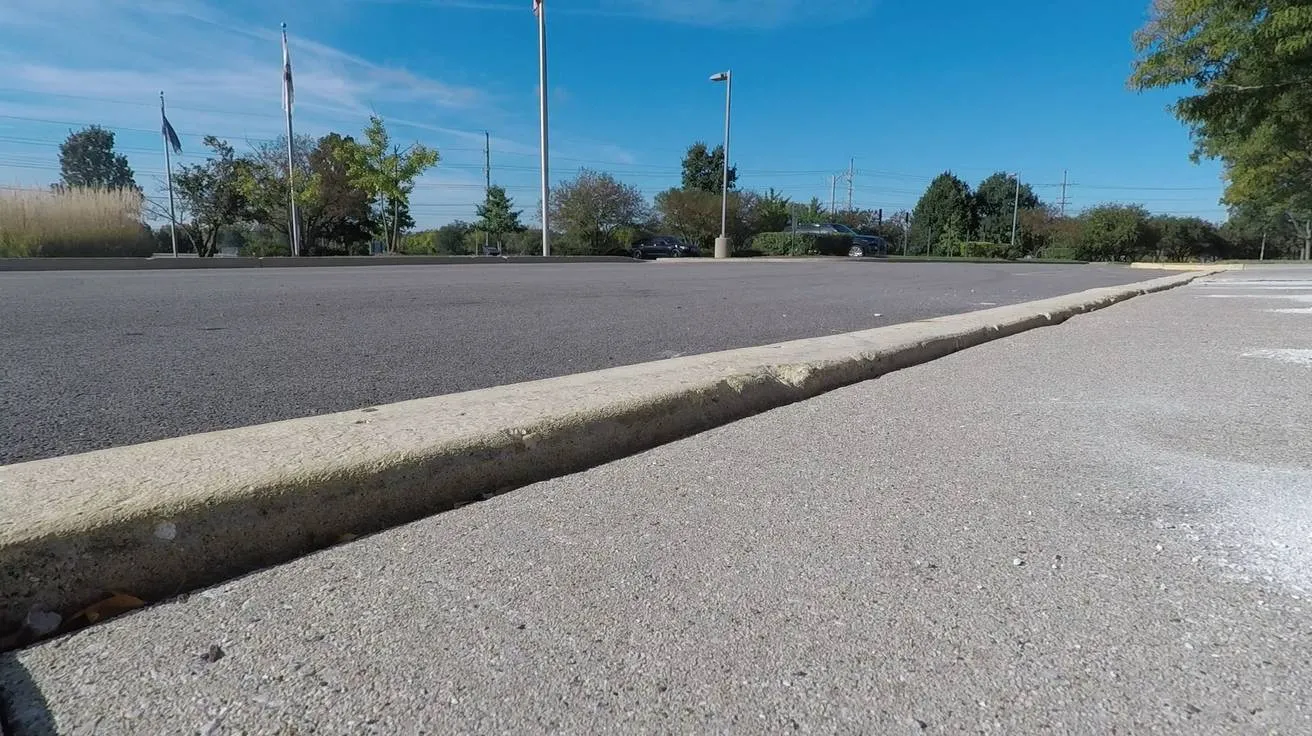
And I do not mean difficult work. I mean pushing the edge of a sidewalk panel back up along a curb — literally the simplest, most straightforward lift there is. In fact, setting up jacks in this case takes longer than the lift does. There are dozens of situations like that where we would never consider the time or the inconvenience, and I watch them getting jacked online all the time.
Part of this is that the equipment is easy to find now, which it was not when I started. Bolt-down jacking systems (and others) are now a new product line. A complete assembly — frame, toe attachment, and an eight-thousand-pound jack — sells online for under a thousand dollars, from some of the same suppliers who sell you foam.
Be precise about who is doing what, though. The suppliers market these as tools that work alongside injection — one describes its jacks as designed to work in unison with its own lifting foams. Nobody is selling a jack as a replacement for learning to lift. A newer operator finds them online, sees a tool that makes concrete go up on command, and reasonably concludes it is the answer to everything. The substitution happens in the field, not in the catalog.
What the foam is actually doing
Here is the part that gets lost, and it matters more than the technique does.
Foam does not start by lifting. On a foam-only lift, the first thing the material has to do is push downward and outward. It is compacting as it expands — working into the soft ground, filling what is open under there, densifying the sub-base beneath the slab. Nothing rises during this phase, and a new operator waiting for movement usually assumes something has gone wrong.
What is happening is that the ground is getting stronger. The foam keeps taking the easiest path available to it, and for a while the easiest path is down and sideways into loose material. It continues until the sub-base will no longer yield — and at that moment the weight of the slab above becomes the path of least resistance instead. That is when the slab starts to move. The lift is the last thing that happens, not the first.
Compaction is only half of what that expansion buys you. The other half is how far the material spreads outward, because support under a slab is not a column beneath each hole — it is a continuous footprint. Foam that travels out and knits between the injection points is what carries the slab afterward. Reach is support.
That is where a jack quietly changes how an operator behaves. Once the slab is already up and sitting at the elevation the customer is going to see, every additional pound of foam becomes a risk instead of a benefit — send too much and the slab goes higher than it should. So you send less. You drill fewer holes. You stop early. I am sure that happens constantly, and the result is a slab held at the right height on an incomplete footprint, with the gaps between the injection points never properly connected.
There is a difference in the foam itself, too. Material that is doing the lifting is working against the weight of the slab, and working against that resistance is exactly what makes it densify. Foam that is only filling a void a jack already opened has nothing to push against, so it expands freely and sets up lighter. Same product, same gun, two different materials by the time they cure — and the one under the jacked slab is the weaker of the two.
So a foam-only lift leaves two things behind: a slab at the right elevation, and a compacted sub-base under it that was not there when you arrived. The repair is not only the position of the concrete. It is the support underneath it.
Lifting the slab mechanically eliminates that entirely. A jack does not care about the ground. It pushes against the slab, the slab goes up, and the sub-base is exactly as loose as you found it. Filling the space afterward is not the same as having compacted it — the material goes into a void already opened to its final size, under no load, with nothing to push against. You have put the slab where the customer wanted it. You have not done the work underneath, and the work underneath is what they are paying for.
The capability you never learn
Not learning the technique is a loss. Never learning what the foam can do is a bigger one.
An operator who jacks from the start never finds out how much a well-planned injection accomplishes on its own — how a slab that looks impossible comes up clean when you start in the right place, how a set of steps can be brought back without touching it mechanically, how much of this work is sequencing rather than force. They never build the instinct for how the material behaves under a heavy slab, in wet ground, along a bound edge. They are operating equipment rather than reading a job.
There is a practical irony in it as well, because technique is not the slow path. In many cases, it is the fast one. An operator who knows where to start, how much to send, and when to move to the next hole gets through a job quicker than one who is rigging hardware to the slab first. Drilling lag holes, setting anchors, mounting a jack, cranking it up, breaking it all back down and then injecting anyway is a stack of steps added to work that did not require them. The crew reaching for a jack to save effort is usually working against itself, and on the simple jobs it is not close.
That knowledge does not survive a generation of crews who never needed it. Skills that go unused stop being taught, and the people who could still teach this learned it the slow way. The suppliers who run formal training for this work still teach lifting technique. It is worth going while that is true.
One jack, and everything hanging off it
There are mechanical costs as well, and they are not small.
Putting the entire lifting load of a slab through a single jack concentrates stress in one place. Concrete does not like that. A slab that would have come up evenly across a spread injection pattern is instead being levered from one point, and the chance of cracking goes up — on a slab you were hired to repair.
Then there are the holes, and I want to be fair about this one. We drill 5/8 inch ports to inject through, and the one bolt-down assembly I found that publishes a spec calls for 3/8 inch bolts — so I am not going to pretend the anchor holes are bigger than the holes we already put in a slab ourselves. Other systems may well call for heavier hardware, and I do not know what each of them requires. Diameter is not the point. The point is that they are additional holes, drilled to carry structural hardware rather than to deliver material, positioned where the jack needs them rather than where the lift needs them, in a slab whose problem was never that it needed anchors.
Add it up and you get extra steps, extra parts, extra holes and extra risk, in a process that in most of these cases needed none of it.
The part that should worry the whole trade
This is the argument I have not heard anyone make, and I think it is a valid one.
Every video of a slab being raised mechanically teaches the public that this is a mechanical job. There are videos online right now of people lifting concrete with floor jacks — they actually seemed proud of it. A great many households own a floor jack.
Follow that where it goes. If raising concrete looks like jacking something up and filling the gap, a homeowner with a floor jack in the garage has no reason to think he needs a contractor. He will crank up his own sidewalk and fill the space with whatever is at hand — sand, gravel, cans of spray foam from the hardware store.
He will not know that the void he just opened is permanent, that nothing under there has been compacted, or that he has left a slab bridging a cavity. He will find out in a year or two, and he will not connect it to the afternoon he spent with the floor jack.
What that does to this trade is turn a skilled repair into a weekend project in the public’s mind. The value of this work rests on it being something a homeowner cannot do — and it genuinely is, if it is to be done correctly. Demonstrating the job as a jack and a gap gives that away, and it feeds the same pressure that already pushes everyone’s price toward the floor.
There is a second-order version of this that worries me more than any single job. The more of it that shows up online, the more it simply reads as how the work is done now. A newer operator does not see a debate, he sees a consensus — and a practice becomes standard operating procedure not because anybody tested it, but because it is what everyone appears to be doing.
Then the arithmetic gets uncomfortable. If skipping the part where foam does the compaction does produce a higher failure rate, those failures will not stay with the companies that caused them. They come back as warranty claims, as callbacks, as homeowners telling their neighbors that the foam did not hold — and it is the foam that will take the blame, not the jack. Polyurethane lifting has spent years earning a reputation as the better repair. That reputation is a shared asset, and it can be spent by people who never helped build it.
You will not find proof of any of this
I cannot point you to a documented failure, and I do not expect to.
No contractor publishes the slab that came back. Nobody writes up the warranty claim, the second trip, or the call from the property manager eighteen months later, identifies the jack as the problem, and then shares that information. If a jacked slab settles again, the only two people who know are the customer and the crew who did it, and neither has a reason to say so. That is not evidence the problem does not exist. It is the reason it can grow for years without anyone in the trade having to answer for it.
So the argument has to come from mechanism. If the ground under a slab was never compacted, then lifting the slab mechanically has changed nothing about the ground. What happens next is a matter of time and moisture, not opinion.
The bottom line
Keep jacks in the truck. Use them on the slab that has earned one.
But learn to lift with foam first, and learn it on the hard jobs, because that is where the knowledge is. An operator who can bring up a set of awkward porch steps with nothing but a pattern of holes and some patience can do everything the operator with the bolt-down rig can do — and knows what is happening under the slab while he does it.
It is the easier tool, not the better repair.