If you own a concrete raising (or any other) business, you’ve probably looked at a CRM, estimating platform, scheduling tool, or automation and thought, “I wish this worked a little differently.” That’s a reasonable thought. Most business tools get some things right and some things painfully wrong — especially when they’re built for broad service industries instead of a specialized trade like concrete raising.
This issue isn’t limited to concrete raising. Service businesses everywhere are seeing the same trend: AI makes it easier to create tools, apps, and automations that look useful on the surface. But concrete raising is a perfect example of why surface-level tools aren’t enough. Specialized trades have specialized workflows, and those details matter.
AI has changed what feels possible. A person can describe an idea in plain English and quickly create screens, forms, workflows, dashboards, and basic automations. That’s exciting, and it shouldn’t be dismissed — AI is becoming a powerful tool for building faster, testing ideas, and improving how businesses operate.
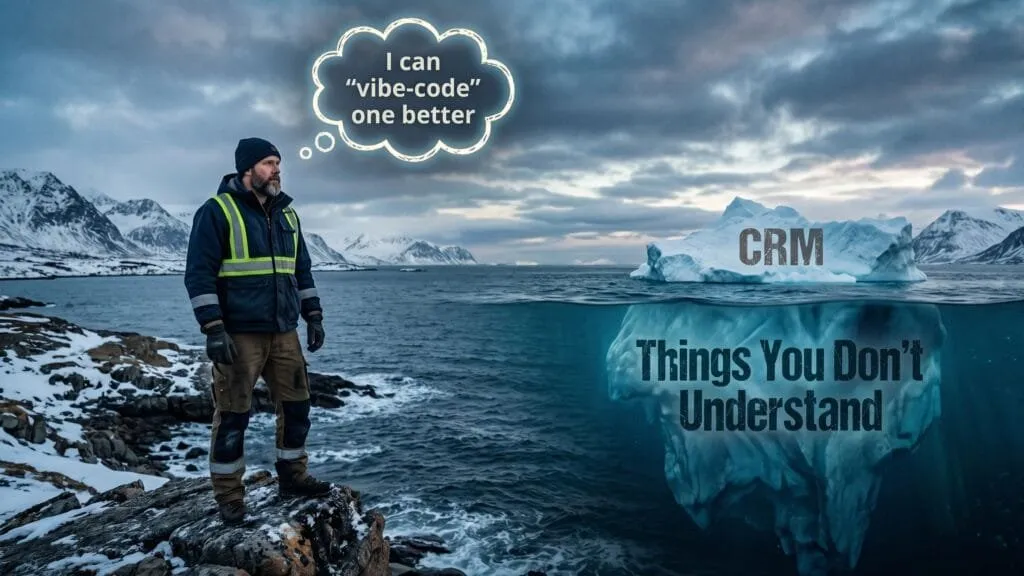
But AI can also create a false sense of simplicity. The danger isn’t that AI exists. The danger is believing that a working screen means you’ve built a dependable business tool. In reality, the visible part of an app or automation is only a small piece of what makes it useful, reliable, and safe for real companies to use every day.
That’s the iceberg problem.
The part everyone sees is only the surface
When most people look at a tool like a CRM or estimating platform, they see the part above the waterline: customer records, estimate screens, calendars, job notes, follow-up buttons, photo uploads, reports, and maybe a few automations that move information from one place to another. That visible part matters — if the interface is confusing or the workflow feels awkward, the tool becomes frustrating fast.
But the interface isn’t the whole product. It’s the part people can point to, click on, complain about, and compare to other tools. Underneath that surface is where the heavier work lives: the technical decisions, structure, safeguards, testing, maintenance, and operational discipline that make a tool dependable instead of merely impressive in a short demo.
That’s the part most people never see when they use an established platform. They see the screen, not the years of decisions beneath it. They see the finished workflow, not the lessons learned from broken workflows, support calls, customer complaints, rebuilds, and real-world usage. The mass below the waterline is what gives the tool stability.
AI can help create the visible portion faster than ever before. It does not automatically create everything underneath it.
It feels easy until you learn what’s missing
The early stages of AI-assisted development can feel deceptively productive. A screen appears. A button works. A record saves. A workflow moves from one step to the next. That progress feels real because, in one sense, it is real. Something has been created.
But early progress isn’t the same as readiness. This is where overconfidence enters the picture — especially combined with not knowing what you don’t know. A person may not recognize how much is missing because they’ve never had to build, maintain, support, secure, or scale a business tool before. They’re judging the iceberg by the part sticking out of the water.
That’s not a character flaw. It’s a knowledge gap. Many concrete raising owners are excellent operators, salespeople, problem-solvers, and technicians. They understand customers, crews, equipment, material, weather, scheduling, and the daily pressure of keeping work moving. But building a serious tool for other companies is a separate discipline. It requires a different kind of experience, a different tolerance for complexity, and a long-term commitment that goes far beyond getting something to work once.
Concrete raising is not a generic market
The same principle applies to HVAC, landscaping, plumbing, and roofing, but concrete raising makes the point especially clear. On the surface, it may look similar to other home service businesses: leads come in, estimates go out, jobs get scheduled, crews complete the work, and customers pay. But anyone who has actually run a concrete raising business knows the details aren’t generic.
Concrete raising involves details that generic tools often miss: lead qualification, site conditions, trip hazards, crew routing, documentation, warranty expectations, seasonal swings, and follow-up. The way those pieces fit together matters.
That’s why domain knowledge isn’t just helpful. It’s foundational.
If someone is building a tool for a specific sector, they shouldn’t be starting from a blank slate and asking basic questions about what the market needs. Customer feedback is valuable, and strong products should always be refined through real user input. But refinement is very different from discovery. The strongest position is to already understand the pain because you’ve lived it.
A tool built for concrete raising should come from firsthand experience — from someone who understands what it feels like when calls are coming in, estimates are stacking up, crews need direction, customers need follow-up, and the season is moving fast. It should come from someone who has used existing systems, felt where they fall short, and understands which features sound good in theory but don’t actually help in the field.
That lived experience changes the product. It affects what gets built, what gets ignored, what gets simplified, and what gets treated as mission-critical. Without that experience, even a technically functional tool can miss the mark.
The best tools come from the overlap
The strongest business tools are built at the intersection of industry experience and technical discipline. Either side by itself is incomplete.
A technically skilled builder who doesn’t understand concrete raising may create something clean, modern, and well-structured that still doesn’t fit the way contractors actually work. On the other hand, an experienced contractor with no technical foundation may understand the problems clearly but underestimate what it takes to build a tool that’s dependable for other businesses.
The overlap is where the opportunity is.
That’s the perspective behind Poly Service Pros. Technology should serve the realities of the business, not force contractors into generic workflows. That belief comes from firsthand experience running a concrete raising company — using existing systems, seeing where they help, seeing where they fall short, and recognizing where better tools and automations can create real operational value.
The goal isn’t to chase technology for the sake of technology. The goal is to apply real service-business experience to practical tools and automations that solve problems owners actually deal with: missed calls, lead capture, customer communication, follow-up, operational bottlenecks, and the systems that help a company run with less chaos.
In the concrete raising industry, that matters. A tool shouldn’t simply imitate a generic CRM with a few trade-specific labels attached. It should reflect how the business actually works, from the first customer interaction to the final job note.
AI is an advantage when it’s used responsibly
None of this means AI should be avoided. Quite the opposite. AI can be a major advantage when it’s used responsibly. It can speed up development, help test ideas, improve internal workflows, support automation, and make small teams more capable than they could have been a few years ago.
But AI should accelerate serious work, not replace serious judgment. Even with firsthand industry experience, building dependable tools requires patience, testing, revision, and respect for the complexity below the surface. The right approach isn’t to assume the hard parts disappear because AI can move quickly. It’s to use AI as an advantage while staying honest about the responsibility that comes with building something other businesses may depend on.
Final thought
AI has opened the door for more people to build tools, software, and automations. That’s a good thing when the work is approached with the right level of seriousness. But the concrete raising industry — and service businesses in general — deserve more than surface-level tools built around assumptions.
The screen is not the product. The demo is not the system. The prompt is not the plan.
Dependable tools require field experience, clear judgment, technical discipline, and long-term responsibility. That’s why Poly Service Pros is positioned differently. We’re not approaching concrete raising from the outside, guessing at what contractors need. We’re building from firsthand industry experience, with a clear understanding of the daily pressures, workflow gaps, and hidden technical requirements that determine whether a tool becomes useful or just another piece of software people tolerate.
That’s the standard the industry should expect. Better tools start with better understanding.